Posts

Showing posts with the label Buddhism

Buddhist Mummy in India

Image
The Indian Mummy The Indian Mummy: "The one and only Buddhist Mummy" in India, sitting in a mysterious manner at Gue village of Spiti valley. This is a naturally preserved mummy, and done with self sacrifice. There are 11 such mummies around the world, all are Buddhists and mostly at Japan, Tibet and India has this one. Nestled deep within the Trans-Himalayan cold desert of the jazed in Himachal Pradesh is the tiny village of Gue which is relatively unknown and unheard of in the traveller circuit. The village of Gue is situated at an altitude or around l0,499 feet above sea-level and is only a few kilometres away from the Indo-china border. Gue also houses India's only known naturally preserved mummy. The villagers still believe in the mummy as their living god and worship the mummy for guidance. The mummy is in a squatting position dressed in silk robes. The teeth and hair are still well preserved and the mummy is kept in a glass chamber in a small enclosure close to the...

"Unity In Diversity" Is From a Javanese Poem

Image
  BHINNEKA TUNGGAL IKA Phrase "Unity in Diversity" is from a Sanskritic Javanese poem that says the Buddha and Śiva may appear different, but are yet the same? It is the official motto of Indonesia. Bhinneka Tunggal Ika is the official national motto of Indonesia. The phrase in Old Javanese translates as "Unity in Diversity". It is inscribed in the Indonesian national symbol, Garuda Pancasila  and is mentioned specifically in article 36A of the Constitution of Indonesia. The name of Garuda is inspired by a mythical bird, the mount of Lord Vishnu and the Buddhist gold bird king, King Garuda. It is a quotation from an Old Javanese poem Kakawin Sutasoma , written by Mpu Tantular during the reign of the Majapahit empire sometime in the 14th century, under the reign of King Rājasanagara , also known as Hayam Wuruk . Kakawin contains epic poems written in metres. This poem is notable as it promotes tolerance between Hindus (especially Shivaites) and Buddhists. These word...

Birth Place of Buddhism

Image
Important Buddhist sites in India. A pictorial presentation. BODH GAYA   The site of the enlightenment of Gautam Buddha  under a tree and top site in the list of world heritage sites in India.  The Mahabodhi Temple, a UNESCO World Heritage Site, is an ancient, but much rebuilt and restored, Buddhist temple in Bodh Gaya, marking the location where the Buddha is said to have attained enlightenment.         KUSHINAGAR       Kushinagar is a pilgrimage town in the Kushinagar district of the Indian state of Uttar Pradesh. It is an important Buddhist pilgrimage site, where Buddhists believe Gautama Buddha attained Parinirvana after his death.  SARNATH     It is the site of the Buddha's Dhamma-cakka-pavattana Sutta, which was his 1st teaching after attaining enlightenment, in which he taught 4 noble truths:  World is full of suffering,. Desire is the cause of suffer...

Buddhist Site of Amaravati

Image
AMARAVATI                The present capital area has its own historical significance of having recorded its first ever legislation 2,200 years ago. The present-day capital region includes the ancient Amaravati. The area has been ruled by the Mauryas, Satavahanas, Ikshvakus, Vishnukundina, Pallavas, Telugu Cholas, Kakatiyas, Delhi Sultanate, Musunuri Nayaks, Bahmani Sultanate, Vijayanagara Empire, Sultanate of Golconda and Mughal Empire successively before the founding of the Nizam of Hyderabad in 1724. It was ceded to France in 1750 but was captured by England in 1759. Amaravati was a seat of Buddhism prior to the rise of Satavahanas, and a stupa and monastery were built there during the reign of Emperor Ashoka (269-232 BC) under Mauryan empire. The great stupa or Mahachaitya at Amaravati was one of the biggest in Andhra Pradesh with a probable diameter of 50 meters and a height of 27 meters. Buddhist legends of Amaravathi...

Nagarjunakonda: Ancient Buddhist town in Andhra Pradesh

Image
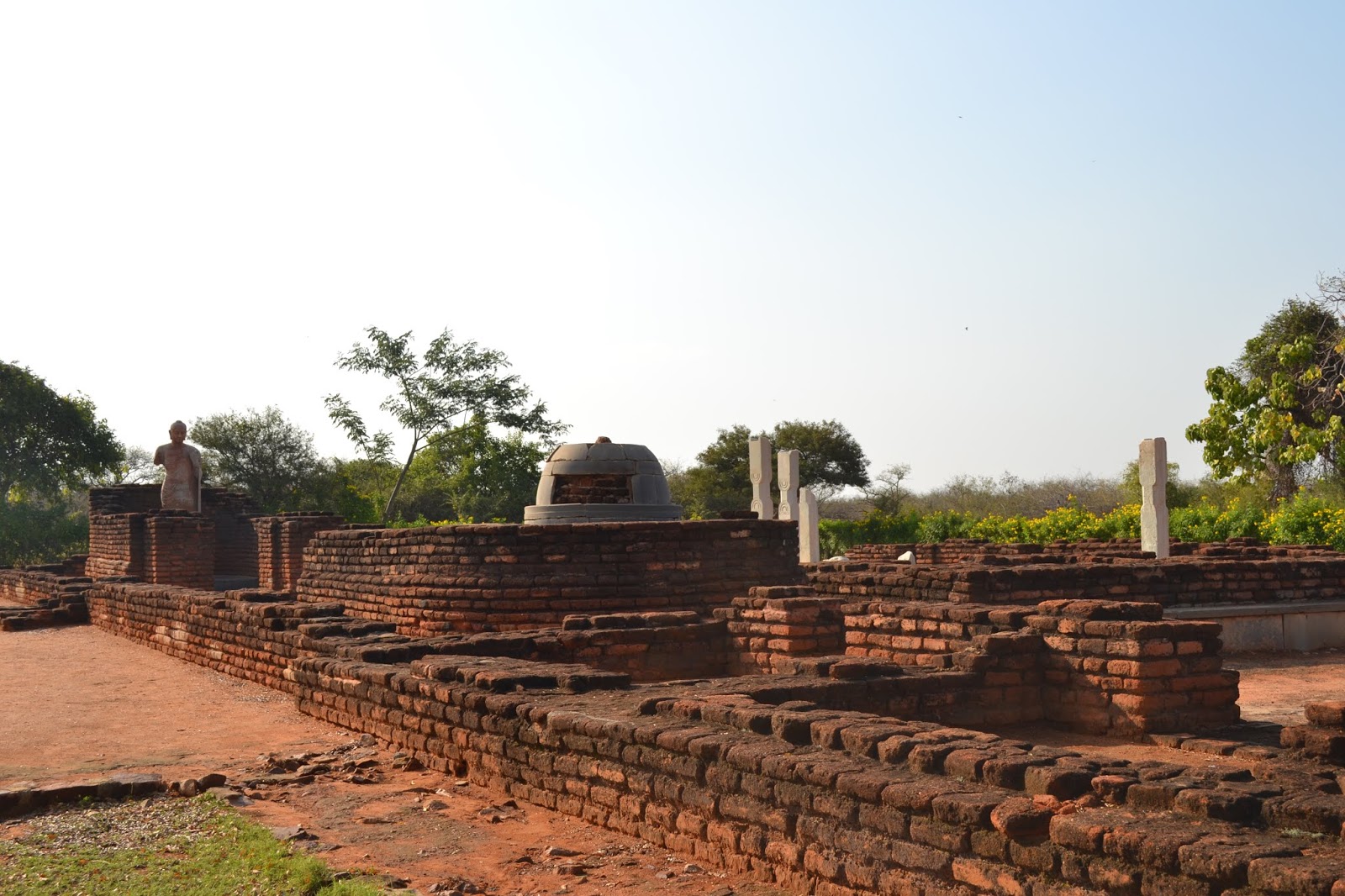
NAGARJUNAKONDA About 1700 years ago, Nagarjunakonda used to be a prosperous Buddhist town in Andhra Pradesh. What had been a successful centre in earlier times, has been preserved in the form of an island at present. Infact, it is one amongst the 20 major Buddhist sites in India. It is 160 km west of important historic site Amaravati Stupa. The ruins of several Mahayana Buddhist and Hindu shrines are located at Nagarjunakonda. It is one of India's richest Buddhist sites, and now lies almost entirely under the Nagarjunasagar Dam. At the time of dam's construction, to save this site from submersion beneath the Nagarjuna Sagar Dam, all relics were collected brick by brick to contour the similar town.  Amphitheater (about 1700 years old) It can accommodate about a thousand spectators. It is a unique example of architecture in ancient India.  It encloses a rectangular area 16.46 x 13.72 m. The place could have been used for sports and wrestling a...

Engagements


Click to know more