Bhagavad Gita on Prakrati or Nature and Its Three Qualities
 |
| Scientist's Theory |
|
Contents v The Bhagavad-Gītā - Five Fundamental
Truths v Prakrati or Nature According To
Bhagavad-Gītā v Two Types of Creation: Material (Apara Prakrati) & Spiritual (Para Prakrati) v Three Modes of Material Nature or Trigunatmak Prakrati ·
Three types of Worship ·
Three types of Food ·
Three types of Sacrifice ·
Three types of Austerity ·
Three types of Charity ·
Three types of renunciation ·
Three types of Knowledge ·
Three types of Action ·
Three types of Worker ·
Three types of Intelligence ·
Three types of Determination ·
Three types of Happiness |
 |
| Vedic View of Creation: Universes Emanate From Body of God (Mahavishnu) |
|
Understanding the Context from Bhagavad Gita  Bhagavad Gita is a manual for the mankind to perform his work or Karma appropriately and succeed in life’s mission. Karma embodies the law of cause and effect, the cosmic principle dictating the consequences of one’s actions. Every thought, word, and deed sets into motion a ripple effect, shaping one’s destiny and influencing future experiences. The five’ Ws’ of what is when, where, why and how the work has to be performed has to be ascertained. Answer to these questions cannot
be correctly determined unless one comprehends the qualities, and principles
of four other eternal constants which form the back ground of work. The
eternal constants in the backdrop of which work is done are Supersoul, soul,
nature and time. 1. Supersoul, God,
Ishwar, or Paramatma: These are some of the different names given to the Supreme cosmic
authority. He is the omnipotent force governing the universe. He eternally
exists. 2. Soul or
Jiva: It
signifies the individual souls, the myriad living entities traversing the
cosmic journey of existence. Also known as Atma, Anu atma, and Jivatma. It is
also eternal. 3. Prakrati or
Nature:
Understanding Prakrati unveils the intricate tapestry of creation, wherein
the material realm serves as the canvas upon which life and karmas unfold. Its existence is also
eternal 4. Time or
Kaal: Kaal
symbolizes the eternal flow of time, an omnipresent force shaping the fabric
of existence. It is an inexorable entity which governs the cosmic order,
orchestrating the cycles of creation, maintenance and dissolution. Time is
energy of the Supreme Lord. This Kaal is also eternal. 5. Work or
Karma: While
the Lord, the living entity, material nature, and time are eternal, karma,
the fifth element, is not. It is a variable which is under human control, though
within limits. Although we may be experiencing the consequences of our
actions since time immemorial, the effects of karma are not eternal. The
Bhagavad Gita imparts instructions from the Supreme Lord, providing the
opportunity to alter the outcomes of our actions and, thereby, our destiny.
|

In this article we will discuss Prakrati or Material Nature
|
Part 1 |
Part
1: Creation of Prakrati |
||
|
Two types of creation: Material
& Spiritual Bhagavad Gita divides creation or manifest nature or
prakrti into two broad types. The two types of creation are material
& spiritual. Shri Krishna speaks the following verses on the subject. 1. Material
Nature (also called Para Prakrati
or Bhinna Prakrati): Earth, water,
fire, air, ether, mind, intelligence and ego – all together these eight
constitute My separated material energies. B.G.7.4 2. Spiritual
Nature (also called Apara Prakrati):
Besides these, O mighty-armed there is another, superior energy of Mine,
which comprises the living entities who are exploiting the resources of this
material, inferior nature. B.G.7.5 All created
beings have their source in these two natures. Of all that is material and
all that is spiritual in this world, know for certain that I am both the
origin and the dissolution. B.G.7.6
Explanation Of the two prakrati, the Jiva (living entity) is
conscious and is therefore superior. The material nature is not conscious and
is therefore inferior. It is important to understand that modern sciences
have no clues about the spiritual part of creation i.e. living force, soul or
spirit within creation. Because
of being conscious living entity tries to control material nature and tries
to be Ishwar or God, but actually,
it is always under the control of the Supreme, because it is also prakrati.
God is the controller Bhagvad Gita
further says the following. This (Prakrati)
material nature, which is one of my energies, is working under My direction,
O son of Kunti, producing all moving and nonmoving beings. Under its own rule
this manifestation is created and annihilated again and again. B.G.9.10 Explanation The material
nature is not independent. It works under His control. The manifestation of
the material nature is not illusion. It is accepted as real but temporary.
The material manifestation takes place at a certain interval stays for a
while and disappears. It is like the coming of the rainy season which
nourishes the crops, but when the rain clouds disappear the crop dries
up. This cycle is working eternally. God is the seed giving Father, Nature is the Mother The total
material substance, called Brahman, is the source of birth, and it is that
Brahman that I impregnate, making possible the birth of all living beings.
B.G.14.3 It should be
understood that all species of life, are made possible by birth in this
material nature, and that I am the seed giving father. B.G.14.4 The living
entities in this conditioned world are My eternal fragmental parts. Due to
conditioned life, they are struggling very hard with the six senses, which
include the mind.B.G.15.7
Explanation The living
beings are a combination of material nature and spiritual nature. All these
appearances are due to the mother, material nature and the God’s seed giving
process, but it appears that they are products of material nature. The Lord is
the cause of all the manifestations of living entities in the material world.
(The various forms of living beings at the time of creation are due to their
past deeds or karma) |

|
Part 2 |
Part 2: Three Modes of Material
Nature or Trigunatmak Prakrati |
|||
|
Material nature
consists of three modes 1. Satvik /
Goodness 2. Rajsik / Passion 3. Tamsik / Ignorance When material living
being comes in contact with nature, he becomes conditioned (infected) by
these modes. |
|||
|
|
B.G. 14.5 |
||
|
|
|
||
|
Saatvik
Gun: |
It is purer; It is
Illuminating; it is free from sinful reactions; it gives a
sense of happiness and knowledge to the person. |
||
|
Rajsik
Gun: |
It is born of
unlimited desire and longings; It bounds one to result oriented material
actions. |
||
|
Tamsik Gun: |
It is born of
ignorance; It creates delusion, madness, indolence & sleep; it binds
conditioned soul (to repeated birth & death, desires, etc). |
||
|
|
B.G.14.6-8 |
||
|
|
|
||
|
Saatvik Gun |
It leads to
happiness. |
||
|
Rajsik Gun |
It leads to
activity. |
||
|
Tamsik Gun: |
It leads to madness
because it covers the knowledge. |
||
|
|
B.G.14.9 |
||
|
|
|
||
|
Saatvik Gun |
Person
manifests knowledge as all the gates of body are illuminated. |
||
|
Rajsik Gun: |
Person manifests
great attachment, fruitive activity, intense endeavor, uncontrollable
desire & hankering. |
||
|
Tamsik Gun |
Person manifests a
state of darkness, inertia, madness & illusion. |
||
|
|
B.G.14.11-13 |
||
|
|
|
||
|
Saatvik Gun
|
On its development
person lives the way pious/ knowledgeable / disciplined / righteous people
live. |
||
|
Rajsik Gun
|
Rajsik Gun:
On its development person lives among
people performing intense result oriented activities to enjoy worldly
results. |
||
|
Tamsik Gun |
On its development
person becomes foolish or animalistic and lives among such. |
||
|
|
B.G.14.14-15 |
||
|
|
|
||
|
Saatvik Gun |
It is said that its result is pure because of
performance of pious actions. |
||
|
Rajsik Gun |
Its result in misery. |
||
|
Tamsik Gun |
Its result in ‘agyan’
or absence or loss of knowledge. |
||
|
|
B.G.14.16 |
||
|
|
|
||
|
Saatvik Gun |
Person develops real
knowledge (spiritual). |
||
|
Rajsik Gun |
Person develops
greed. |
||
|
Tamsik Gun |
Person develops foolishness,
madness & illusion. |
||
|
|
B.G.14.17 |
||
|
|
|
||
|
Saatvik Gun |
Person moves towards
a higher state of existence by being situated in this ‘gun’. |
||
|
Rajsik Gun |
Person is situated in
a medium and average state of existence. |
||
|
Tamsik Gun |
Person move towards
hellish life by being situated in abominable activities and occupation. |
||
|
|
B.G.14.18 |
||
|
|
|
||
Further discription of ‘Teen Gun’ or the three modes of material nature |
|||
|
Sometimes the mode of goodness becomes prominent,
defeating the modes of passion and ignorance, O son of Bharat. Sometimes the
mode of passion defeats goodness and ignorance and at other times ignorance
defeats goodness and passion. In this way there is always competition for
supremacy. B.G. 14.10
The spirit soul bewildered by the Influence of
false ego thinks himself the doer of activities that are in actuality carried
out by the three modes of material nature. B.G. 3.27
When one properly sees that in all activities no
other performer is at work than these modes of nature and he knows the
Supreme Lord, who is transcendental to all these modes, he attains My
spiritual nature. B.G. 14.19
When the embodied being is able to transcend these
three modes associated with the material body, he can become free from birth,
death, old age and their distresses and can enjoy nectar even in this life. B.G. 14.20 |
|||
|
Method To Transcend The Modes
Of Material Nature Arjuna
inquired: O my dear Lord, by which symptoms is one known who is
transcendental to these three modes? What is his behavior? And how does he
transcend the modes of nature? B.G. 14.21 Lord Shri Krishna said: O son of Pāṇḍu,
he who does not hate illumination, attachment and delusion when they are
present or long for them when they disappear; who is unwavering and
undisturbed through all these reactions of the material qualities, remaining
neutral and transcendental, knowing that the modes alone are active; who is situated
in the self and regards alike happiness and distress; who looks upon a lump
of earth, a stone and a piece of gold with an equal eye; who is equal toward
the desirable and the undesirable; who is steady, situated equally well in
praise and blame, honor and dishonor; who treats alike both friend and enemy;
and who has renounced all material activities – such a person is said to have
transcended the modes of nature. B.G. 14.22-25 One who engages in full devotional service,
unfailing in all circumstances, at once transcends the modes of material
nature and thus comes to the level of Brahman. B.G.14.26 |
|||
|
|
|||
|
Explanation The Bhagavad-Gītā
teaches that material nature is composed of three fundamental forces or
qualities known as the tri-guṇa: Sattva (Goodness), Rajas
(Passion), and Tamas (Ignorance). These modes act as the psychological
and physical "binding agents" that condition the living entity upon
contact with the material world. The Three Modes and Their
Effects Each mode manifests
distinct characteristics that influence a person's behavior, destiny, and
consciousness:
The Dynamics of Nature Within a person these
three modes are in a constant state of competition for supremacy. At any
given time, one mode may dominate the others, dictating an individual’s
current disposition. Significantly, the Gītā explains that while the
soul thinks it is the "doer" of activities, it is actually the
three modes of nature carrying out all actions through the false ego. Transcendence The ultimate goal is
to transcend these modes. A person who achieves this state—the guṇātīta—remains neutral and unwavering amidst the shifts
of material nature. They view happiness and distress, or gold and stone, with
an equal eye. The most direct path to this transcendence is through unalloyed
devotional service. By fixing the consciousness on the Supreme, who is
transcendental to these modes, the living entity becomes free from the
distresses of birth, old age, and death, attaining the level of Brahman even
in this life |
|||


|
Part 3 |
Part
3: Three Modes of Material Nature or Trigunatmak
Prakrati in Practice |
|
Bhagavad Gita Chapter 17 describes three types of Worship, Food, Sacrifice, Penance and Charity. |
THREE TYPES OF POOJAN / WORSHIP (B.G.
17.4-6)
|
MEN WHO ARE IN GOODNESS (SATVIK)
|
MEN WHO ARE IN PASSION (RAJSIC)
|
MEN WHO ARE IN IGNORANCE (TAMSIC)
|
|
-Worship
Demigods or Devtas. (Devotees
of God who are given affairs of universal government are Devtas) |
-Worship
Demons -Sometimes
worship powerful men, -Create
their own gods (Those
who undergo severe austerities and penances not recommended in the scriptures,
performing them out of pride and egoism; Impelled by lust and attachment
torture the body and the Supersoul within are demons) |
-Worship
Ghosts and spirits |
|
*Gun-aatit/ Transcendental Situation |
Worship the supreme person
|
|
THREE TYPES OF AAHAR / FOOD (B.G.
17.8-10)
|
MEN WHO ARE IN GOODNESS (SATVIK)
|
MEN WHO ARE IN PASSION (RAJSIC)
|
MEN WHO ARE IN IGNORANCE (TAMSIC)
|
|
|
-Eat
that food that increases duration of life, purify ones existence, give
strength, happiness and satisfaction. -Such
foods are juicy, fatty, wholesome and pleasing to the heart. |
-Eat
foods that are bitter, too sour, salty, hot, pungent, dry and burning. -Cause
distress, misery and disease. |
-Eats
foods prepared many hours before being eaten, tasteless, decomposed and
putrid, consisting of remnants and untouchables. |
|
|
*Gun-aatit/ Transcendental Situation |
Food first offered to the God or
Guru. |
||
|
GOODNESS (SATVIK)
|
PASSION (RAJSIC)
|
IGNORANCE (TAMSIC)
|
|
-According
to the directions of scriptures -As
a matter of duty -Who
desire no rewards |
-Performed
for some material benefit -For
the sake of pride |
-Performed
without regard for the directions of scriptures, without distribution of
Prasad, -Without
chanting of Vedic hymns and remuneration to the priests and -without
faith |
THREE TYPES OF TAPASYA / AUSTERITIES (PENANCE) (B.G.
17.14-19)
|
What is Austerity, Tapasya or Penance? Austerity of the body: Consists
in worship of the Supreme Lord, the Brahmans, the spiritual master and
superiors like the father and mother. Cleanliness,
simplicity, celibacy and nonviolence Austerity of speech: Speaking
words that are truthful, pleasing, beneficial and not agitating to others. Reciting
Vedic literature Austerity of the mind: Satisfaction,
simplicity (no duplicity), gravity, self-control and purification of one’s
thought and existence |
||
|
GOODNESS (SATVIK)
|
PASSION (RAJSIC)
|
IGNORANCE (TAMSIC)
|
|
-Performed
with transcendental faith -Not
expecting material benefits -For
the sake of (satisfaction of) Supreme |
-Performed
out of pride -For
gaining respect honor and worship -Which
is not stable or permanent |
-Performed
out of foolishness -With
self-torture -With
the purpose of destroying or injuring others |
THREE TYPES OF DAAN / CHARITY (B.G.17.20-22)
|
GOODNESS (SATVIK)
|
PASSION (RAJSIC)
|
IGNORANCE (TAMSIC)
|
|
-Given
out of duty -Without
expectation of return -At
the proper time and place -To
a worthy person |
-Expectation
of some return -Desire
for fruitive results -Given
in grudging mood |
-Performed
at an impure place and time -To
unworthy persons without proper attention and respect |
|
*For Sacrifice penance and charity to
be Gun-aatit (Transcendental) they should be
directed at the Supreme by beginning with ‘Om-Tat-Sat’ to indicate the
supreme. This means that they should be performed according to scriptures,
directed at the Supreme and performed to please the supreme. (B.G.17.23-28) |
||
Bhagavad Gita Chapter 18 describes three types of renunciation, knowledge, actions, workers, intelligence, determination, and happiness. The chapter begins with Arjuna asking what renunciation is, and Shri Krishna explaining the same to him.
What
is Tyaga or Renunciation?
Shri Krishna says Renunciation
can take any of the following forms.
·
Giving up activities
based on material desire.
·
Giving up the results
/ fruits of all activities.
·
Giving up all type of
material or result oriented activities all together.
·
Performing all
activities as a matter of duty.
·
Even while following
the above, never giving-up acts of sacrifice, charity and penance, because
these acts purify even the elevated souls.
B. G. 18.2-6
THREE TYPES OF TYAGA / RENUNCIATION (B.G.
18.7-11)
|
GOODNESS (SATVIK)
|
PASSION (RAJSIC)
|
IGNORANCE (TAMSIC)
|
|
-Performs
prescribed duty only because it ought to be done. -Renounces
all attachment to the fruits of action. -Neither
hateful of inauspicious work nor attached to auspicious work |
-If
one gives up his prescribed duties because they are troublesome or fear of
bodily discomfort. |
-If
one gives up his prescribed duties because of illusion |
THREE TYPES OF GYAN / KNOWLEDGE (B. G.18.20-22)
|
GOODNESS (SATVIK)
|
PASSION (RAJSIC)
|
IGNORANCE (TAMSIC)
|
|
-That
knowledge by which one undivided spiritual nature is seen in all living
entities, though they are divided into innumerable forms, |
-That
knowledge by which one sees that in every different body there is a different
type of living entity. |
-That
knowledge by which one is attached to one kind of work as all in all, without
knowledge of the truth, and which is very meager. |
THREE TYPES OF KARMA / ACTION (B. G.18.23-25)
|
GOODNESS (SATVIK)
|
PASSION (RAJSIC)
|
IGNORANCE (TAMSIC)
|
|
-Action
that is regulated and which is performed without attachment, without love or
hate, and without desire for fruitive results. |
-Action
performed with great effort by one seeking to gratify his desires, and
enacted from a sense of false ego |
-Action
performed in illusion, in disregard of scriptural injunctions, and without
concern for future bondage or for violence or distress caused to others |
THREE TYPES OF KARTA / PERFORMERS OF ACTION / WORKER (B. G.18.26-28)
|
GOODNESS (SATVIK)
|
PASSION (RAJSIC)
|
IGNORANCE (TAMSIC)
|
|
-One
who performs his duty without association with the modes of material nature,
without false ego, with great determination and enthusiasm, and without
wavering in success or failure |
-The
worker who is attached to work and the fruits of work, desiring to enjoy
those fruits, and who is greedy, always envious, impure, and moved by joy and
sorrow |
-The
worker who is always engaged in work against the injunctions of the scriptures,
who is materialistic, obstinate, cheating and expert in insulting others, and
who is lazy, always morose and procrastinating. |
THREE TYPES OF BUDDHI / UNDERSTANDING / INTELLIGENCE (B. G.18.30-32)
|
GOODNESS (SATVIK)
|
PASSION (RAJSIC)
|
IGNORANCE (TAMSIC)
|
|
-That
understanding by which one knows what ought to be done and what ought not to
be done, what is to be feared and what is not to be feared, what is binding
and what is liberating |
-That
understanding which cannot distinguish between religion(duty) and
irreligion(non duty), between action that should to be done and action that
should not be done |
-That
understanding which considers irreligion (adharm) to be religion (dharm) and
religion to be irreligion, under the spell of illusion and darkness, and strives
always in the wrong direction |
THREE TYPES OF DHRITY / DETIRMINATION (B.G.
18.33-35)
|
GOODNESS (SATVIK)
|
PASSION (RAJSIC)
|
IGNORANCE (TAMSIC)
|
|
-That
determination which is unbreakable, which is sustained with steadfastness by
yoga practice, and which thus controls the activities of the mind, life and
senses is determination in the mode of goodness |
-That
determination which one holds fast to fruitive results in religion, economic
development and sense gratification is of the nature of passion |
-That
determination which cannot go beyond dreaming, fearfulness, lamentation,
moroseness and illusion- such unintelligent determination is in the mode of
darkness |
 |
| TamsicGuna: Lust & Greed |
THREE TYPES OF SUKHAM /HAPPINESS (B. G.
18.36-39)
|
GOODNESS (SATVIK)
|
PASSION (RAJSIC)
|
IGNORANCE (TAMSIC)
|
|
-That which in the beginning may be
just like poison but at the end is just like nectar and which awakens one to
self-realization i |
-That
happiness which is derived from contact of the senses with their objects and
which appears like nectar at first but poison at the end |
-That
happiness which is blind to self-realization, which is delusion from
beginning to the end and which arises from sleep, laziness and illusion |
|
Part 3 - Conclusion The Bhagavad Gita's teaching on the three gunas shows that every aspect of human life - worship, food, sacrifice, austerity, charity, knowledge, action, determination, and happiness - is shaped by inner nature. Satvik qualities elevate a person toward purity, wisdom, balance, and self-realization. Rajsic qualities keep one bound to desire, restlessness, ego, and attachment to results. Tamsic qualities lead to ignorance, delusion, carelessness, and spiritual decline. Through this classification, Shri Krishna helps us examine not only what we do, but also why and how we do it. The ultimate message is not merely to become satvik, but to rise beyond all three modes by acting according to scripture, giving up selfish motives, and dedicating all actions to the Supreme. Thus, the Gita offers a practical guide for inner purification, right living, and gradual progress from material conditioning toward transcendence and lasting peace.
|

 |
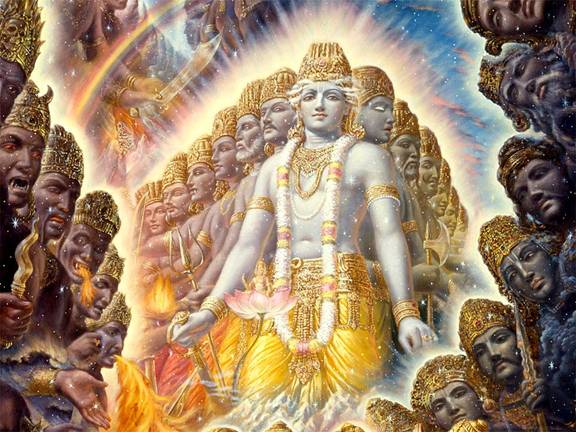
| When Arjun saw the Universal form of God as creator, maintainer & destroyer- He was bewildered and afraid. |


Comments
Post a Comment